
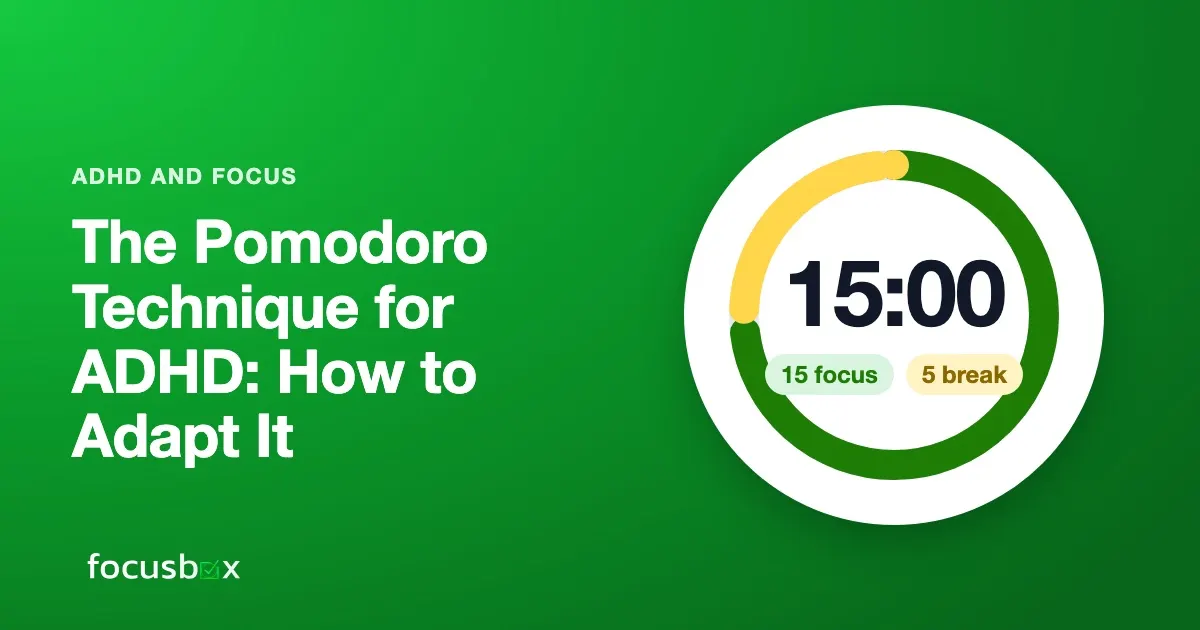
The Pomodoro technique for ADHD works best as a starting tool, not a rulebook. A short, visible countdown makes a task easier to begin and puts time outside your head. The standard 25 minutes on, 5 off often fails with ADHD because it cuts off hyperfocus and lets breaks drift. Shorten or lengthen the interval, plan the break, and allow a flexible end.
Key Takeaways
- No clinical trial has tested the Pomodoro technique in people with ADHD. The closest evidence is a set of student studies on break schedules, with mixed results.
- The useful part for ADHD is the external timer: a short, fixed commitment and a clock you see.
- The common failures are an arbitrary 25-minute default, breaks that turn into scrolling, and a bell that interrupts rare deep focus.
- Treat the numbers as settings: 15/5 for hard starts, 50/10 for absorbing work, and permission to keep going when focus is real.
Is the Pomodoro technique good for ADHD?
It helps some people, but the evidence is thin. There are no randomized trials of the method in people with ADHD. CHADD lists the Pomodoro technique and visual timers among strategies for time blindness at work, which is expert advice rather than trial data. Student studies of break schedules disagree with each other, so the honest answer is to test it on yourself for a week.
Those student studies come from Maastricht University. In 2023, students given fixed breaks (24 minutes on, 6 off, or 12 on, 3 off) reported less fatigue and distraction than students who chose their own breaks, and finished the same work in less time. A 2025 trial found no overall difference between self-chosen, Pomodoro and “Flowtime” breaks, though fatigue rose faster in the Pomodoro group. A 2026 trial with 176 students found self-chosen breaks gave better mood and equal test scores. None of them measured ADHD. What is known about ADHD study methods beyond breaks is collected in a separate guide. Pomodoro is one of ten strategies we rate by evidence in how to focus with ADHD.
For the basics, see the Pomodoro technique definition on the main site or our longer introduction to Pomodoro.
Why does a timer help with ADHD?
A timer takes over two jobs that ADHD makes harder: judging how much time has passed and deciding when to stop. A 2023 review of adult ADHD research found deficits in time estimation, time reproduction and time management in several studies, though results varied. A countdown you see replaces that internal estimate. And “work for 15 minutes” is smaller than “finish the report”.
Pomodoro does not treat ADHD; NIMH lists medication and psychosocial interventions such as cognitive behavioral therapy for that. What it changes is the size of the first step. Many people describe a wall in front of starting, often called “ADHD paralysis”. That is a lay term, not a diagnosis, for the task-initiation difficulty linked to executive function. A short, bounded interval is a lower wall. Francesco Cirillo’s own site adds that the timer is only the starting point: the full method also includes daily planning, interruption management and effort estimation.
Where does the Pomodoro technique fail for ADHD?
It fails in three predictable places. The bell breaks a rare stretch of deep focus, and getting back in is hard. The 25-minute default is arbitrary: too long on a bad day, too short once you are absorbed. And the break has no edges, so five minutes on your phone becomes forty. The fix for each is to change the rule, not to try harder.
Hyperfocus gets interrupted. Researchers who built a hyperfocus questionnaire describe the state as intense focus that includes “difficulty stopping and switching tasks”, and found it correlates with ADHD traits. ADHD UK is blunt: for big projects, Pomodoro “can be a disaster”. Our guide to working with hyperfocus covers the other side.
The break swallows the session. A break with no plan defaults to the most stimulating thing nearby. Opening a feed is easy; coming back from one is not.
Restarting is the hard part. Pomodoro assumes you pick the thread up again after five minutes. With ADHD, the second start is often as hard as the first.
How do you adapt the Pomodoro technique for ADHD?
Keep the structure (one task, a visible countdown, a real break) and change everything else. Match the interval to the task and the day, decide the break activity before the timer starts, and set a rule for when focus is going well. The table maps each failure point to an adaptation.
| Problem | Adaptation | How to set it |
|---|---|---|
| Can’t start | Shorter interval | 15 on, 5 off, or 10 on, 3 off |
| Bell rings mid-flow | Flexible end | Extend once by 10 to 25 minutes, then take a longer break |
| Absorbing work | Longer interval | 50 on, 10 off, close to the 52/17 split |
| Break turns into scrolling | Break menu | Pick the break before you start: water, stretch, a short walk |
| Time slips away | Visible timer | Keep the countdown on screen, not in a background tab |
| Restart is hard | Written next step | Before each break, write the first action for the next interval |
ADDA’s Pomodoro guide backs the flexible end: if you have reached a flow state, breaks are optional. Some people also start faster with steady ambient sound for ADHD focus.
To find your numbers, run a one-week test. Days 1 and 2 at 15/5, days 3 and 4 at 25/5, day 5 at 50/10. After each session note two things: did you start within two minutes of setting the timer, and did you come back after the break? Keep the interval with the most yeses.
How FocusBox supports an ADHD-friendly Pomodoro
FocusBox has timer templates you load in one click. The ADHD-Friendly Pomodoro template describes 15-minute work sessions, a 5-minute break after each, and a longer break every three cycles. The Quick Pomodoro (15-Minute) template is one 15-minute session and a 5-minute break, meant for small tasks and starting the day.
Each task has its own countdown that you increase or decrease, which covers the flexible end. Alarms are visual only or visual plus sound, and repeat until dismissed. Full-screen mode keeps the timer front and center, and ambient sounds are configurable to pause during breaks. FocusBox is a productivity app, not an ADHD treatment. For other tools, see our roundup of Pomodoro timer apps.
Frequently Asked Questions
Are Pomodoro timers good for ADHD?
They help many people start tasks and notice time passing, and CHADD lists them among time-blindness strategies. There is no ADHD-specific trial, and student studies point in different directions. Use a visible timer, adjust the interval, and judge it by whether you start and return. If ADHD is affecting your work or health, talk to a clinician.
What is the 10-3 rule for ADHD?
It is an informal rule shared by ADHD clinics and coaching sites: 10 minutes of focused work, then a 3-minute break, repeated (adhdmoodbehaviorcenter.com, September 2026). It has no clinical definition, and we found no study testing it in ADHD. The closest tested schedule is the 12-minute, 3-minute condition in the 2023 Maastricht student study.
How long should a Pomodoro be with ADHD?
There is no evidence-based number. Start at 15 minutes for tasks you avoid and 25 to 50 for work you find absorbing, then keep whatever lets you start quickly and come back after the break.
Sources
- The Pomodoro Technique, official site of Francesco Cirillo (accessed September 2026)
- Biwer F, et al. Understanding effort regulation: Comparing “Pomodoro” breaks and self-regulated breaks. British Journal of Educational Psychology, 2023
- Smits EJC, Wenzel N, de Bruin A. Investigating the Effectiveness of Self-Regulated, Pomodoro, and Flowtime Break-Taking Techniques Among Students. Behavioral Sciences, 2025
- Göksu A, Wiradhany W, de Bruin ABH. When to Take a Break: Comparing Effects of Systematic Short (Pomodoro) and Self-Regulated Breaks. Behavioral Sciences, 2026
- Mette C. Time Perception in Adult ADHD: Findings from a Decade, A Review. IJERPH, 2023
- Hupfeld KE, et al. Validation of the dispositional adult hyperfocus questionnaire (AHQ-D). Scientific Reports, 2024
- CHADD, Time Unbound: Managing Time Blindness at Work (Attention, February 2024)
- ADDA, Pomodoro Timer and ADHD tips
- NIMH, Attention-Deficit/Hyperactivity Disorder
- ADHD UK, Pomodoro Technique: The good and the bad