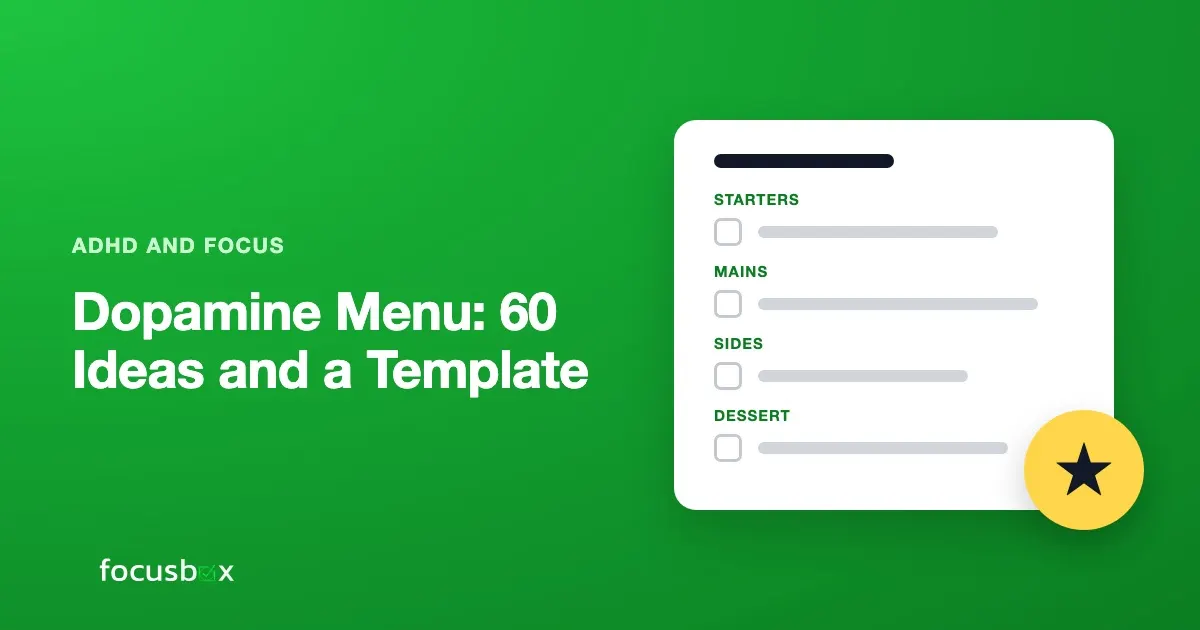
A dopamine menu is a written list of activities you find rewarding, sorted like a restaurant menu: quick appetizers, longer entrees, sides you pair with dull tasks, and desserts to ration. You pick from it when you feel bored, stuck or restless, instead of grabbing your phone. The idea comes from the ADHD community, and it works as a decision shortcut, not a brain chemistry fix.
Key Takeaways
- The concept traces to a 2020 How to ADHD video by Jessica McCabe; several writers also credit ADHD coach Eric Tivers.
- The four core sections are appetizers, entrees (or mains), sides and desserts. Some versions add specials.
- Dopamine is mostly about wanting, learning and anticipation, not pleasure itself. “Dopamine hit” is a loose metaphor.
- No study has tested the menu itself. The closest evidence is behavioral activation, which plans rewarding activities on purpose.
- Give every item a natural end. Desserts cause trouble because feeds and autoplay have none.
What is a dopamine menu?
A dopamine menu, sometimes written “dopamenu”, is a personal list of activities that reliably make you feel more engaged, grouped by how long they take and how easily they spiral. It exists because a bored or stuck brain makes poor choices on the spot, and boredom tends to hit harder with ADHD. Deciding in advance, while calm, means the choice in the moment is a glance at a list.
The restaurant format is deliberate: a menu limits options and signals size. People with ADHD often describe a vague wish for stimulation and no idea what would satisfy it, so the default wins, and the default is usually a screen. If that “stuck” feeling is familiar, our guide to ADHD paralysis covers the freeze itself.
Who came up with the idea?
The usual origin is a 2020 YouTube video by Jessica McCabe of the How to ADHD channel, according to researchers writing in The Conversation in December 2023. Psychology Today and the blog I’m Busy Being Awesome credit McCabe together with Eric Tivers, an ADHD coach and host of the ADHD reWired podcast. It spread widely on social media from there.
The menu came from people describing their own coping, which is how many useful habits start. It also means the brain claims attached to it on social media came later, and they deserve the second look we give them below.
What sections does the menu have?
Every version agrees on four sections: appetizers, entrees (also called mains or main courses), sides and desserts. Some versions add a fifth, specials, for rare treats. The sections sort activities by time and by risk, so you know what fits a five-minute gap and what to keep on a short leash.
| Section | What it is | Typical length | Main risk |
|---|---|---|---|
| Appetizers | Quick resets that take five minutes or less | 1 to 5 minutes | Few; they end on their own |
| Entrees | Activities that take longer and fill you up | 30 minutes or more | Needs planning, so it gets skipped |
| Sides | Add-ons you pair with a boring task | As long as the task | Can distract from the task they serve |
| Desserts | Strong, easy, fleeting pleasures | Open-ended | Expands to fill the day |
| Specials | Bigger rewards for once a month or once a season | Hours to a day | Planned and then postponed forever |
What are good dopamine menu ideas?
Good ideas are specific, cheap and already proven on you. “Exercise” is too vague; “walk to the corner shop and back” is an item. Below are 60 ideas, 12 per section, to borrow from. Cross out anything that does nothing for you and keep the ones that made you think “oh, yes”.
Appetizers (under five minutes). Make a coffee and drink it away from the screen. Do 20 jumping jacks. Step outside and look at the sky for one minute. Play one song loud and sing along. Stretch your arms and back. Pet the dog or cat. Text a friend a meme. Water one plant. Smell something you like: coffee beans, a candle, an orange. Do one easy crossword clue. Doodle for three minutes. Tidy one small surface.
Entrees (30 minutes or more). Walk in a park. Go for a run or a bike ride. Cook a new recipe. Play an instrument. Read a chapter of a novel. Call a friend properly, not by text. Work on a craft or model kit. Garden for an hour. Swim. Write in a journal. Play a board game with someone. Fix something that has been broken for months.
Sides (paired with a dull task). A podcast while you fold laundry. An upbeat playlist while you do email. A fidget toy during calls. A standing desk for admin work. Ambient sound while writing. A favorite drink at your desk. Working from a café. A body double on a video call. An audiobook on the commute. Walking meetings. A timer you race against. Doing chores while on the phone with a friend.
Desserts (ration these). Social media. Short-form video. Online shopping. Mobile games. A TV episode. YouTube. Checking the news. Reddit. Sweets. Group chats. Rewatching a favorite show. Scrolling photo apps.
Specials (rare, planned). A concert. A day trip. A spa visit. A new hobby kit. A weekend away. A meal at a restaurant you have wanted to try. A festival. A long hike. A visit to an old friend. A new book from an author you love. A museum exhibition. A camping night.
What does dopamine actually do?
Dopamine is a chemical messenger involved in motivation, learning and reward. It is not the pleasure chemical. Research led by Kent Berridge found that blocking dopamine reduces how much animals “want” a reward but not how much they “like” it, and that pleasure itself depends more on opioid and related systems. Dopamine drives wanting and anticipation.
This is where many popular guides get it wrong. Psychology Today calls dopamine “the ‘feel-good’ neurotransmitter,” and other popular write-ups call it the “feel-good hormone”. Berridge, Robinson and Aldridge write that “suppression of endogenous dopamine neurotransmission reduces ‘wanting’ but not ‘liking’.” Work by Wolfram Schultz adds a second piece: dopamine neurons respond most to rewards that are better than expected, stay at baseline for fully predicted rewards, and dip when a reward falls short. Dopamine is a learning and motivation signal about surprise and value.
What about ADHD? A 2009 JAMA brain imaging study of 53 unmedicated adults with ADHD and 44 controls found lower dopamine receptor and transporter availability in reward pathway regions, linked to inattention. That supports the idea that reward and motivation work differently in ADHD, which psychiatrist William Dodson describes as an interest-based nervous system. It does not show that a walk or a song “tops up” dopamine, and nobody has measured dopamine before and after using a menu like this. For the wider science, read why people with ADHD look for dopamine.
So why use one? The best evidence is indirect. Behavioral activation, which plans rewarding activities on purpose, improved well-being with a moderate effect (g = 0.52) across 20 trials and 1,353 people in a 2010 meta-analysis. A menu is a homemade version of that planning step. Planned rewards are a form of extrinsic motivation, and research on rewards shows when they help and when they backfire.
How do you make a dopamine menu?
Build it in one 20-minute sitting when you are calm, not when you are bored. List what already lifts you, sort each item into a section, give each one a natural end, then put the menu where your hand goes when you get restless. Revise it after a week, because the first draft always contains items you never use.
- Collect. For two or three days, note what left you more awake or settled.
- Sort. File each item by length and by how easily it runs over.
- Add an exit. Write how each item ends: “one song”, “back by 3:15”.
- Place it. Desk, fridge or lock screen, never a folder.
- Trim. After a week, delete what you never chose and promote what worked.
The exit rule is our own addition. Appetizers rarely cause trouble because they end by themselves: the song finishes, the coffee is gone. Feeds, autoplay and “next episode” have no end built in, so an exit written in advance turns a vague treat into a bounded one.
Is there a dopamine menu template you can copy?
Yes. Copy the table below into a notes app, a doc or a sheet of paper and fill in your own items. The Exit column is the part most templates leave out: write how each activity ends before you start it. Keep three to six items per section so the menu stays a menu and not another list to scroll.
| Section | Item | Time | Exit (how it ends) | Good for |
|---|---|---|---|---|
| Appetizer | Make coffee, drink it by the window | 5 min | Cup is empty | Between focus blocks |
| Appetizer | 20 jumping jacks | 1 min | Count reaches 20 | Afternoon slump |
| Entree | Walk to the park and back | 40 min | Back at the front door | After a long work block |
| Side | Podcast while folding laundry | 20 min | Basket is empty | Chores |
| Dessert | One TV episode | 25 min | Credits roll, autoplay off | End of the workday |
| Special | Concert with a friend | Evening | Planned date | Once a month |
How do you use the menu during a workday?
Use appetizers inside your breaks and sides inside your work, and keep entrees and desserts for after a block is done. The menu works best when it has a slot in the day. A short break with no plan tends to become a dessert; a break with an appetizer already chosen tends to end on time.
Here is a worked example. You start a 25-minute focus block on a report. Before you start, you pick the appetizer for the break: jumping jacks and a glass of water. The side during the block is an instrumental playlist. When the timer rings you do the appetizer, then start the next block. After four blocks you take an entree, a 30-minute walk, and the episode waits until the evening with autoplay switched off. This pairs naturally with the Pomodoro Technique for ADHD, whose short breaks are the natural home for appetizers (see the Pomodoro Technique glossary entry for the classic timings).
When does the menu backfire?
It backfires when desserts take over, when the menu becomes procrastination with a nicer name, or when building the perfect menu replaces doing anything from it. The usual sign is that a five-minute break ends 90 minutes later in a feed. The fix is exits and order: appetizers during work, desserts after the main task is done.
Desserts eating the day is the most common failure. Feeds and autoplay are built so the next item arrives before you decide to stop. Pick desserts that end, set the exit before you open the app, and move them after the work rather than between blocks. If you notice that “taking a break” has become the main activity, our guide to ADHD procrastination is the better next read.
The second failure is perfectionism: an hour spent designing a pretty menu, then never used. A rough list on a sticky note beats a beautiful one in a drawer. If ideas are stuck in your head, a quick brain dump gets them on paper first.
When should you get professional help?
The menu is a self-help tool. It does not treat ADHD, depression or anything else. If boredom, restlessness or low motivation regularly affect your work, studies or relationships, see a doctor. The NHS advises adults whose ADHD symptoms affect studies, work or relationships to make a GP appointment to find out what support is available.
Treatment for ADHD can include medicines started and monitored by a specialist, and talking therapies such as CBT, according to the NHS. The NHS also lists “having no motivation or interest in things” as a symptom of depression, and says to see a GP if symptoms last most of the day, every day, for more than 2 weeks. If nothing on your menu appeals anymore, mention it. The FocusBox ADHD test is a screening tool, not a diagnosis.
How FocusBox fits into your menu
FocusBox is a productivity app built with ADHD and timeboxing in mind. It is not a treatment, but it gives the menu a place in your day. Pomodoro and custom timers set a countdown for each task, so a five-minute appetizer break can be its own timed task, with an alarm that tells you, with sound and visuals, when it is over.
Celebrations play an animation such as confetti when you complete a task, with a duration you set from seconds to minutes, which works as a small built-in appetizer. Templates let you load a ready-made routine into your daily tasks and edit it, so a day with breaks already planned is one click away. The Energy Audit maps tasks to your energy levels, which helps you decide when an entree should land.
Frequently Asked Questions
What is a dopamine menu for ADHD?
It is a list of activities you find rewarding, sorted into appetizers, entrees, sides and desserts, that you choose from when you need stimulation. It came out of the ADHD community, where boredom and restlessness often lead to the easiest option instead of the most satisfying one.
Does the menu actually increase dopamine?
Nobody has measured that. Dopamine changes with many everyday activities, but no study has tested this kind of menu’s effect on brain chemistry. The better-supported reason to use one is behavioral: planning rewarding activities in advance improved well-being in behavioral activation trials.
What should I put on my menu?
Activities you already know lift you, written specifically: “one song and a dance” instead of “music”. Aim for three to six per section, with more appetizers than anything else, and give each item a clear end point.
Are desserts bad?
No. They are on the menu so you choose them deliberately rather than by default. Set an exit before you start, such as one episode with autoplay off, and save them for after the main task.
Is it the same as a dopamine detox?
No. A detox removes stimulation; the menu plans it. The detox idea also leans on a misreading of dopamine as a pleasure chemical that you overdose on.
Sources
- Davidson and Hutchinson. Dopamine menus: the science behind the trend, and how it might help people with ADHD (The Conversation, December 2023, accessed October 2026)
- CHADD, ADHD in the News: Dopamine menus (chadd.org, accessed October 2026)
- Ascher and Ascher. Dopamine for ADHD: Creating a Dopa-menu (psychologytoday.com, June 2024, accessed October 2026)
- How To Create an ADHD Dopamine Menu (imbusybeingawesome.com, accessed October 2026)
- Berridge, Robinson and Aldridge. Dissecting components of reward: ‘liking’, ‘wanting’, and learning (Current Opinion in Pharmacology, 2009)
- Schultz. Dopamine reward prediction error coding (Dialogues in Clinical Neuroscience, 2016)
- Volkow et al. Evaluating dopamine reward pathway in ADHD: clinical implications (JAMA, 2009)
- Mazzucchelli, Kane and Rees. Behavioral activation interventions for well-being: a meta-analysis (Journal of Positive Psychology, 2010)
- ADHD in adults (NHS, accessed October 2026)
- Symptoms of depression in adults (NHS, accessed October 2026)