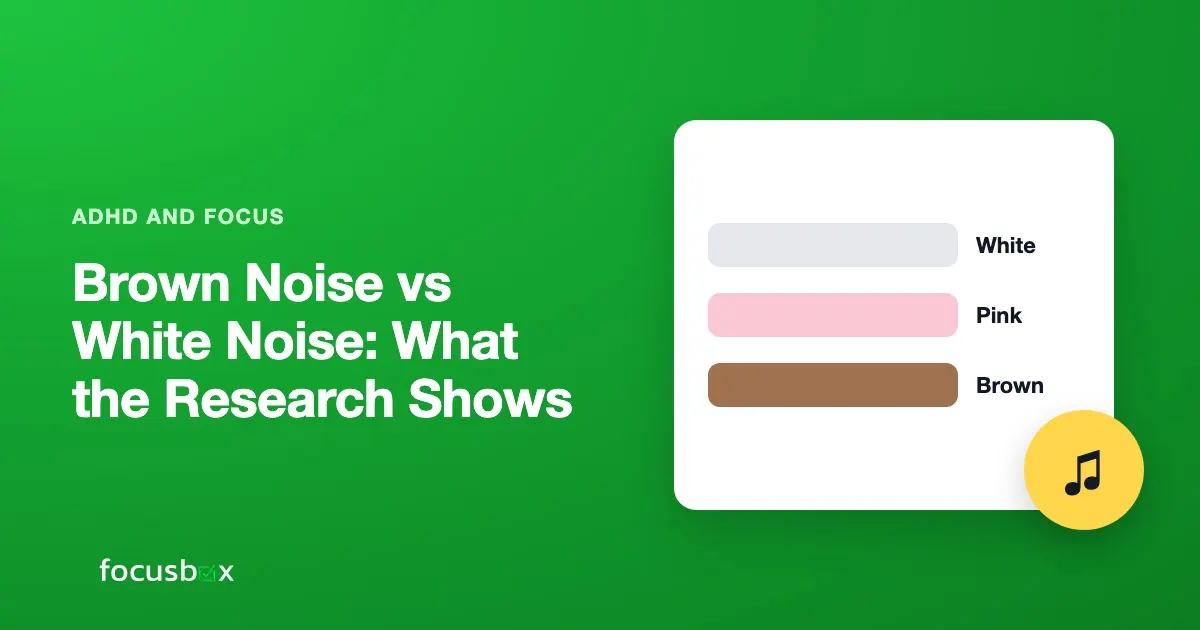
Brown noise vs white noise comes down to where the energy sits; both are random, steady sounds. White noise has equal power at every frequency, so it sounds like a bright hiss. Brown noise loses 6 dB of power per octave as pitch rises, so it sounds like a deep rumble. White noise has a small research base for ADHD focus. Brown noise has almost none.
Key Takeaways
- White noise is flat, pink noise drops 3 dB per octave, and brown (or red) noise drops 6 dB per octave.
- “Brown” comes from Brownian motion, named after the botanist Robert Brown, not from a color.
- A 2024 meta-analysis found a small benefit of white and pink noise on lab attention tasks for young people with ADHD or high ADHD symptoms, a small harm for people without ADHD, and no brown noise studies at all.
- For sleep, the evidence for any steady noise is weak, and a 2026 lab trial found pink noise cut REM sleep by about 19 minutes.
- Volume is the safety question: keep it near conversation level, and keep sound machines away from babies.
How do white, pink, brown, green and black noise compare?
Noise colors describe how sound energy spreads across pitches. White is flat, pink tilts toward the low end, brown tilts further, and green and black are informal labels with no agreed definition. Only white and pink have meaningful research behind them, and even that evidence is small.
| Color | What it sounds like | Energy distribution | Common uses | Evidence |
|---|---|---|---|---|
| White | Hiss, like radio static | Flat: equal power at every frequency | Masking noise, sleep machines, ADHD lab studies | Small attention benefit in ADHD (2024 meta-analysis); weak for sleep |
| Pink | Steady rain | Falls 3 dB per octave, so each octave carries equal energy | Sleep sounds, audio testing | Included in the ADHD meta-analysis; most positive sleep studies in one review, but a 2026 trial found less REM sleep |
| Brown (red) | Low rumble, like a waterfall | Falls 6 dB per octave, strongest in the bass | Focus playlists, sleep | No studies in the 2024 ADHD meta-analysis; one small 2020 work-task study |
| Green | Marketing term for mid-range “nature” noise | No standard definition | Relaxation tracks | Nothing you can pin to a definition |
| Black | Silence, or close to it | Near-zero power | Earplugs, quiet rooms | Earplugs beat pink noise in the 2026 sleep trial |
What is brown noise, in plain terms?
Brown noise is random sound whose power falls by 6 dB each time the frequency doubles. Its spectrum matches Brownian motion, the random jiggle of particles, which is where the name comes from. Because most of its energy is in low frequencies, it sounds deeper and less sharp than white noise.
The numbers make the difference concrete. Take two pitches five octaves apart, 100 Hz (a low hum) and 3,200 Hz (inside the 1,000 to 8,000 Hz band that matters most for understanding partly masked speech). White noise has the same power density at both. Pink noise is 15 dB weaker at 3,200 Hz, about 32 times less power. Brown noise is 30 dB weaker, a factor of 1,000. So at a comfortable volume, brown noise puts very little energy where hiss, chatter and keyboard clicks live, and a lot of energy where traffic and air handlers rumble.
Pink noise vs brown noise: what is the real difference?
Pink noise drops 3 dB per octave and brown noise drops 6 dB per octave, so pink sits halfway between white and brown. Pink sounds like steady rain, brown like a waterfall heard up close. In research the gap is bigger: pink noise appears in 11 sleep studies in one review and in the ADHD meta-analysis, while brown noise has barely been tested.
Brown noise vs white noise: what does research show for focus and ADHD?
The best summary is a 2024 meta-analysis of 13 studies with 335 children and college-age young adults who had ADHD or elevated ADHD symptoms. White and pink noise gave a small benefit on lab attention tasks (g = 0.249). In people without ADHD, noise had a small negative effect. The authors identified no brown noise studies.
Two limits matter. The studies used exposures of several minutes at varied decibel levels, so the best volume and the effect of hours of daily use are unknown. And the authors rated their confidence as moderate, partly because participants cannot be blinded to noise. Noise is one of ten strategies we grade in how to focus with ADHD.
For brown noise, the closest thing we found is a 2020 study of 22 adults comparing quiet, red, pink and white noise on cognitive tests. Red noise beat quiet on several, and only pink helped continuous performance. One small, non-ADHD study cannot rank colors.
This is where we disagree with most pages ranking for this question, which present brown noise benefits as established. On the evidence we could find, brown noise for ADHD is untested rather than disproven. If it helps you, keep using it; it is just not a research finding yet. Music, nature sounds and binaural beats are covered in our guide to ambient sound types for ADHD.
What does research show for sleep?
The sleep evidence for steady background noise is weak and mixed. A 2021 systematic review of 38 studies rated the quality of evidence that continuous noise improves sleep as very low. A 2022 review found positive results in 9 of 11 pink noise studies and 6 of 18 white noise studies, but no strong evidence overall. Neither review included brown noise trials.
In a 2026 University of Pennsylvania trial, 25 healthy adults spent seven nights in a sleep lab. Pink noise at 50 dBA was linked to an 18.6 minute drop in REM sleep versus a quiet night. Adding pink noise to aircraft noise made sleep worse; earplugs blocked most of the aircraft noise effects. The lead author, Mathias Basner, said the results “caution against the use of broadband noise, especially for newborns and toddlers.”
How loud should brown or white noise be?
Keep any noise color close to normal conversation level, which the NIDCD puts at 60 to 70 dBA, and well below 85 dBA, the level at which long or repeated exposure can cause hearing loss. The WHO’s safe listening guidance allows 40 hours a week at 80 dB and suggests keeping devices at no more than 60% of maximum volume.
NIOSH sets its workplace limit at 85 dBA over eight hours, halving the allowed time for every 3 dBA above that. Set the volume once in a quiet moment and leave it there.
Babies need more care. A study in Pediatrics measured 14 infant sleep machines at full volume: all exceeded 50 dBA, the recommended limit in hospital nurseries, at 30 cm, and three went above 85 dBA. The authors warned these levels may damage infant hearing. Children’s National Hospital says the AAP recommends staying below 50 dB, and advises keeping the machine at least two feet from the crib and turning it off once the baby sleeps.
Brown noise vs white noise for studying or sleep: which should you pick?
For studying, start with whatever masks the specific noise that bothers you, at the lowest volume that does it. At the same volume, brown noise covers low rumble well but leaves speech fairly audible, while white or pink covers voices better. For sleep, the evidence favors quiet or earplugs over any color. Treat both choices as personal experiments.
A worked example: you study in a shared apartment with a fridge hum, street traffic and a roommate on calls. The hum and traffic are low-frequency, where brown noise is strongest. The voice is harder: speech research finds that when speech is partly masked, frequencies from 1,000 to 8,000 Hz become increasingly important for understanding it, and brown noise has little energy there. Covering the voice with brown noise means turning it up a lot; pink, or white at a lower level, does it more gently.
To decide, try what we call the three-session swap. Pick one repeatable task, such as flashcards. Do one 25-minute session in silence, one with white or pink noise and one with brown, on different days at the same time and volume. Count output (cards reviewed), not how it felt. If silence wins, believe it; the meta-analysis found noise hurt people without ADHD. Timed sessions fit the Pomodoro technique for ADHD.
When should you get professional help?
Talk to a clinician if you find you cannot work at all without loud noise, if focus problems affect your studies, job or relationships, or if you notice ringing in your ears, muffled hearing or sound sensitivity. The NIDCD recommends a hearing test if you suspect noise-induced hearing loss. Noise can help you focus, and it does not treat ADHD.
If sound overload is part of a bigger pattern of shutting down, see ADHD overwhelm. The FocusBox ADHD test is a screening tool, not a diagnosis.
How FocusBox fits in
FocusBox’s built-in ambient sounds do not include engineered white, pink or brown noise. Its ambient sounds page lists Running Water, Waves, Forest Sounds, Coffee Shop and People Talking, and its FAQ adds rain, fireplace, thunderstorm and birds. Volume is adjustable and saved, sounds play during timed sessions and can pause in breaks, and they work on the iOS app.
For a steady, low-tilted sound bed, Running Water or Waves are the nearest options, since pink noise is often compared to steady rain or ocean waves; they are recordings, not engineered noise. For the three-session swap, set each task’s duration with task design. Apps with noise colors are in our ambient sound apps roundup, and the general theory is in the science of background noise.
Frequently Asked Questions
What’s the best color noise for sleep?
No color has strong evidence. Pink noise has the most positive studies, but reviews rate the evidence as very low to weak, and a 2026 trial found it reduced REM sleep. Earplugs did better against outside noise.
Is it OK to play brown noise all night?
There are no trials of all-night brown noise. The researchers behind the 2026 pink noise trial caution against broadband noise during sleep, especially for babies and toddlers. If you use it, keep it as quiet as still works for you; the 2026 trial measured lost REM sleep with pink noise at 50 dBA. Consider a timer that stops it after you fall asleep.
Is white or brown noise better for you?
Neither, in general. White noise has a small research-backed benefit on attention tasks for people with ADHD symptoms; brown noise has not been studied for that. For people without ADHD, noise slightly hurt performance.
Is there such a thing as black noise?
Yes, with no single definition. It usually means silence or near silence; in practice, a quiet room or earplugs.
Sources
- Colored Noise documentation (MathWorks, accessed October 2026)
- Colors of noise (Wikipedia, accessed October 2026)
- Nigg et al. Systematic Review and Meta-Analysis: Do White Noise or Pink Noise Help With Task Performance in Youth With ADHD or With Elevated Attention Problems? (J Am Acad Child Adolesc Psychiatry, 2024; PMC, accessed October 2026)
- Lu, Huang and Lin. Spectral content (colour) of noise exposure affects work efficiency (Noise and Health, 2020; PMC, accessed October 2026)
- Riedy et al. Noise as a sleep aid: A systematic review (Sleep Medicine Reviews, 2021; PubMed, accessed October 2026)
- Capezuti et al. Systematic review: auditory stimulation and sleep (J Clin Sleep Med, 2022; PMC, accessed October 2026)
- Basner et al. Efficacy of pink noise and earplugs for mitigating the effects of intermittent environmental noise exposure on sleep (Sleep, 2026; PMC, accessed October 2026)
- Pink noise reduces REM sleep and may harm sleep quality (Penn Almanac, accessed October 2026)
- Sabaghypour et al. Echoes of Pink Noise (The Neuroscientist, 2026; PMC, accessed October 2026)
- A broad acoustic bandwidth helps listeners understand fragmented speech (Physics Today, accessed October 2026)
- Noise-Induced Hearing Loss (NIDCD, accessed October 2026)
- Deafness and hearing loss: safe listening (WHO, accessed October 2026)
- About Noise (NIOSH, CDC, accessed October 2026)
- Hugh et al. Infant sleep machines and hazardous sound pressure levels (Pediatrics, 2014; PubMed, accessed October 2026)
- Baby sound machines and hearing loss (Children’s National Hospital, accessed October 2026)