
Interest-Based Nervous System: What It Is and What Helps
The interest-based nervous system is Dr. William Dodson's name for ADHD motivation. Its 4 (later 5) triggers, what research supports, and how to use them.
Prioritizing, breaking work down, recurring tasks and daily reviews, with AI doing the sorting.
ADHD time management, ambient sound for concentration, and a workspace that protects focus.
Timeboxing, Pomodoro, the 52-17 rule and the reasons they work.
Deadlines, breaks, procrastination and the tools behind a productive week.
AI task and timer tools compared, the trends behind them, and where they fall short.
Roundups of to-do, planner, note-taking and timer apps, and free templates.
The interest-based nervous system is Dr. William Dodson's name for ADHD motivation. Its 4 (later 5) triggers, what research supports, and how to use them.
Does ADHD make you tired? Often, yes: 62% of adults with ADHD in one clinic study had significant fatigue. 7 causes, why coffee backfires, and what helps.
ADHD perfectionism is less about high standards than self-judgment: in 3,720 students, more ADHD symptoms went with lower standards but more disappointment.

ADHD waiting mode is a community term for losing hours before one appointment. What nearby research shows, and a 4-step leave-by plan to get your day back.

A doom pile is stuff you moved but never sorted. Why ADHD makes the piles more common, and a 15-minute clear-out with 4 exits so the pile does not come back.

How to study with ADHD: quiz yourself instead of rereading (it worked as well for students with ADHD in 3 of 4 college studies) and plan back from exams.
ADHD object permanence is a community term for out of sight, out of mind. What research on remembering to act shows, and 4 cues that keep things in view.
ADHD and memory: why working memory slips (75% to 81% of children with ADHD in one study), why it is not memory loss, and why reminders beat brain games.
ADHD brain fog is a lay term, not a diagnosis. What it feels like, how it links to CDS, 7 other causes to rule out, and a five-step plan for foggy days.
ADHD hyperfixation is a community term, not a diagnosis. How it differs from hyperfocus, what 4 studies found, and 5 guardrails to keep it from costing you.
ADHD stimming is repetitive movement or sound that helps you regulate. 5 stim types with examples, what the research shows, ADHD vs autism, and quieter swaps.
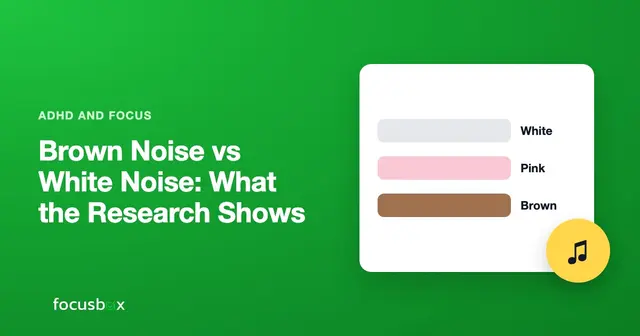
Brown noise vs white noise: how their spectra differ, what studies show for focus, ADHD and sleep, and why a 2024 meta-analysis found zero brown noise studies.

Monk mode means a set period of distraction-free focus with strict rules. What the research supports, what it does not, and a 1-week version you can try.

The 1-3-5 rule caps your day at 9 tasks: 1 big, 3 medium, 5 small. Where it came from, a worked example day, the time math, and an ADHD version.
ADHD accommodations at work, mapped from 9 common struggles to real examples, plus your US and UK rights, the documentation question and an email to adapt.
ADHD burnout is not a diagnosis, and the WHO defines burnout only for work. Symptoms, the boom-bust cycle, how it differs from depression, and 6 recovery steps.
ADHD organization works better as one small system than 33 tips. The Land, See, Reset method for your home, your tasks and your paperwork, plus a tools table.
ADHD overwhelm comes from working memory, emotion and sensory load piling up. How to tell it from a meltdown or shutdown, plus a 10-minute reset to try.
A dopamine menu is a list of rewarding activities sorted like a restaurant menu. 60 ideas, a copyable template, and what dopamine really does, with sources.

ADHD paralysis is not a diagnosis but a real stuck feeling. Why task paralysis happens, how it differs from laziness, and 8 ways to get unstuck, with sources.
ADHD procrastination is tied to inattention, not laziness. What 11 studies show, how it differs from ordinary delay, and 6 fixes matched to the cause.

A brain dump is 5 to 10 minutes of writing down everything on your mind. Learn the method, the 4 buckets to sort it into, and how to turn it into today's plan.
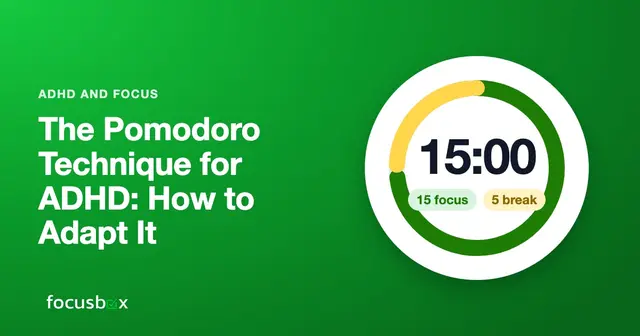
The Pomodoro technique for ADHD: why a timer helps you start, where 25 minutes fails (hyperfocus, lost breaks), and 5 adaptations, from 15/5 to a flexible end.
Compare task prioritization frameworks—Eisenhower Matrix, MoSCoW, RICE—and how FocusBox AI adapts each for smarter productivity in 2026.
Designed for ADHD and Timeboxing: AI To-Do Lists, Timers, and More.